

Written by Ambassador Club member, John Solgat
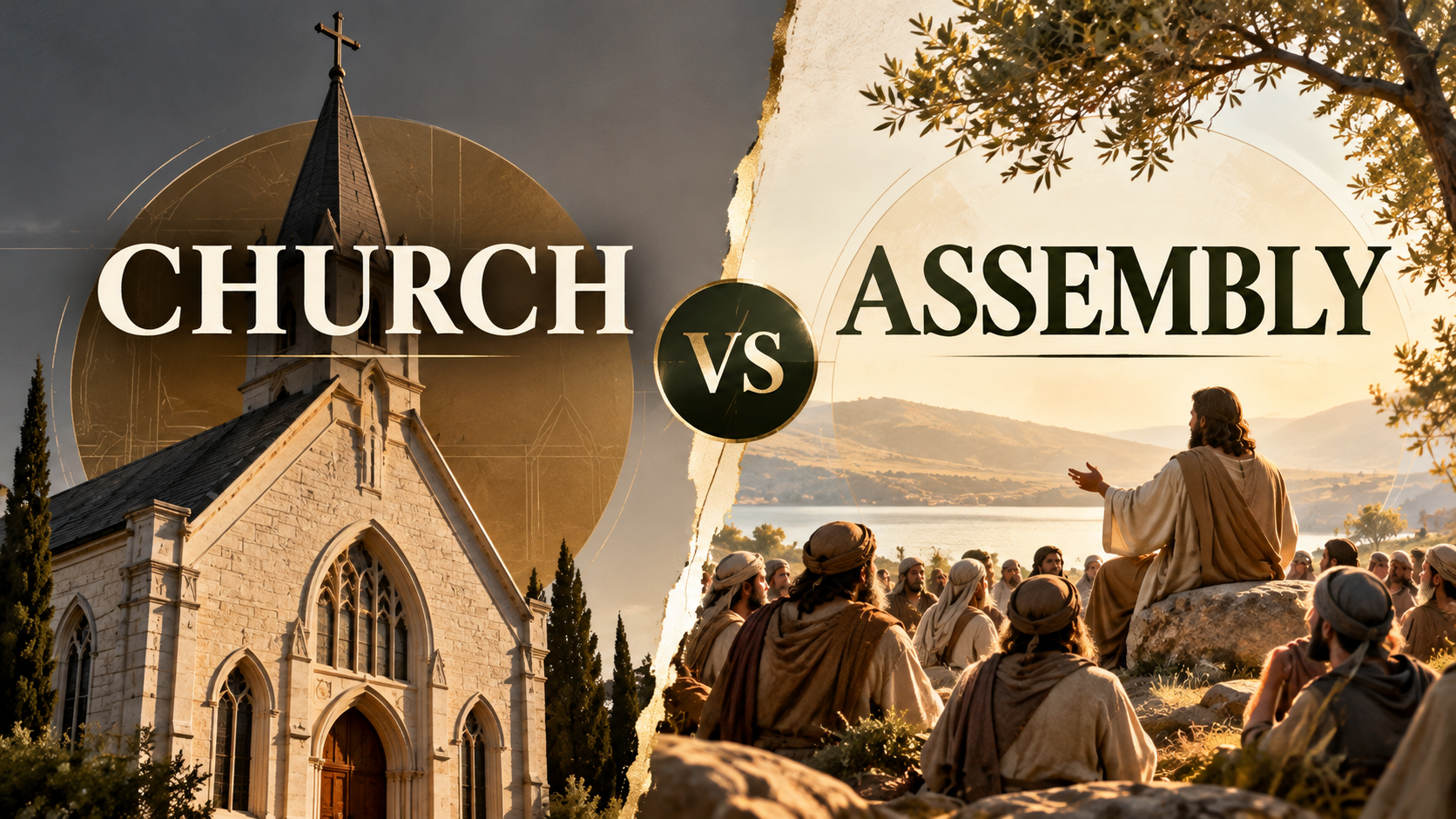
The Church
The English word “Church” can be defined as:
a building for public religious services and especially Christian worship
a body or organization of religious believers
Where does this English word come from? Here is the etymology:
Middle English chirche, from Old English cirice, circe "place of assemblage set aside for Christian worship; the body of Christian believers, Christians collectively; ecclesiastical authority or power," from Proto-Germanic kirika (source also of Old Saxon kirika, Old Norse kirkja*, Old Frisian zerke, Middle Dutch kerke, Dutch kerk, Old High German kirihha, German Kirche).
We find the English word “Church” only in English translations of the New Testament. It is not in the Old Testament/Tanakh. The common belief, though not 100% true, is that the Old Testament/Tanakh was written in Hebrew with a little Aramaic and that the New Testament was written in Greek. Though I believe that most, if not all, of the New Testament was written in Hebrew, not Greek, for the sake of this discussion we will table that discussion and just assume Greek. What Greek word underlies the English word “Church” in the Greek? The answer is “ekklésia” (ἐκκλησία), Strongs 1577 defined as:
(properly) a "calling out"
(concretely) a called-out assembly of citizens
(specifically, of Christ) the community of the Redeemed of Christ whether being on earth or in heaven or both
{used only of people, not a location, structure, etc. Of Christ, used only of the Redeemed, not of the unredeemed in their midst}
An example of a verse using this word in the New Testament would be Matthew 16:18:
And I tell you that you are Peter, and on this rock I will build My church, and the gates of Hades will not prevail against it.
We will come back to this verse shortly.
We also find the word “ekklésia” (ἐκκλησία) in the Septuagint, the Greek translation of the Hebrew Old Testament/Tanakh. Consider an
English translation of Deuteronomy 4:10:
Remember the day you stood before the LORD your God at Horeb, when the LORD said to me, ‘Assemble the people to Me, that I may have them hear My words so that they may learn to fear Me all the days that they live on the earth, and that they may teach their children.’
The Greek in the Septuagint reads (I have highlighted ekklésia):
ἡμέραν ἣν ἔστητε ἐναντίον κυρίου τοῦ θεοῦ ὑμῶν ἐν Χωρηβ τῇ ἡμέρᾳ τῆς ἐκκλησίας ὅτε εἶπεν κύριος πρός με ἐκκλησίασον πρός με τὸν λαόν καὶ ἀκουσάτωσαν τὰ ῥήματά μου ὅπως μάθωσιν φοβεῖσθαί με πάσας τὰς ἡμέρας ἃς αὐτοὶ ζῶσιν ἐπὶ τῆς γῆς καὶ τοὺς υἱοὺς αὐτῶν διδάξωσιν
Since Moses originally wrote this in Hebrew, we need to ask what Hebrew word underlies these translations. That word is haq·hêl (הַקְהֶל), Strong’s 6950, which means:
assemble selves, gather selves together
We need to consider another related Hebrew word, “edah” (עֵדָה), Strong’s 5712, meaning:
a stated assemblage
(specifically) a concourse
(generally) a family or crowd
We find this word in Numbers 31:16 translated as “congregation” or “community”:
Look, these women caused the sons of Israel, through the counsel of Balaam, to turn unfaithfully against the LORD at Peor, so that the plague struck the congregation of the LORD.
The Hebrew word “edah” is translated into Greek as “συναγωγῇ” (sunagógé), Strong’s 4864, meaning:
a gathering of persons
(specially) a Jewish "synagogue" (the meeting or the place)
(by analogy) a religious meeting or building (of Jews, Jewish Christians, Greeks, or even of Satan)
{typically used of the building itself where a gathering or meeting takes place}
Considering that we are quoting Numbers 31:16, well before the Jewish synagogue system was put in place after the Babylonian captivity, the only interesting definition here is the first one, “a gathering of persons.” This is synonymous with the earlier Hebrew and Greek words meaning “assembly.” The Hebrew haqhel and edah, along with the Greek versions of ekklésia and sunagógé, are speaking of the same people, the Israelites. The Israelites are “the assembly,” “the congregation,” or “the community.”
Let us return to Matthew 16:18, where we read in English that Yeshua said, “I will build My church…” That was translated from Greek; “church” comes from “ekklésia.” I am adamant that this conversation between Yeshua and His Israelite/Jewish disciples did not happen in Greek; it most certainly did not happen in English. It happened in Hebrew; this was a group of Hebrews/Israelites of the kingdom of Judah having this conversation. The word spoken was most likely “haqhel,” but we see “church” in English. How is it that “haqhel” or “ekklésia” in the Old Testament/Tanakh/Septuagint gets translated as “assembly,” but magically, when turning past that page inserted between Malachi and Matthew that says, “New Testament,” that the translation suddenly becomes “church?” Look back in this piece and look at the etymology of “church.” Notice all of the German, Dutch, Norse, etc., background to this word. Where did that come from in a Hebrew context conveyed to us through mostly Greek language?
The books of the Hebrew Tanakh (OT) are in a different order than the books in a Christian Bible. In the Christian Bible, Malachi is the last book before you enter the New Testament. I believe that is not coincidence; I believe Yehovah caused that to happen very intentionally so that just before we turn the page to enter the New Testament, we will read in Malachi 3:6:
Because I, the LORD [Yehovah], do not change, you descendants of Jacob have not been destroyed.
Yehovah is gracious to tell us before leaving the Tanakh that “He does not change.” And, just so you don’t miss it, only a few pages later we find Yeshua reiterating that in [Matthew 5:17-19]