

Written by Executive Producer Mike Molinar
THE BLUEPRINT SHIFT | Part 2: Crossing into the Decapolis — The Land of the "Ten Cities"
In Part 1, we saw Yeshua confront the scribes and Pharisees over their man-made traditions. He proved that human rules and ceremonial hand-washing have zero power over a person’s heart—and that religious fences cannot limit the reach of YHVH.
So what did Yeshua do immediately after exposing their artificial authority?
He packed up, turned His back on the religious establishment in Galilee, and walked directly into "unclean," pagan, non-Jewish territory.
Here is the breakdown of the journey that changed the mission field forever:
1. The Faith of an "Outsider" (Matthew 15:21–28)
First, Yeshua traveled northwest into the region of Tyre and Sidon (modern-day Lebanon). This was strictly Gentile land.
There, a Canaanite woman approached Him, crying out for her demon-possessed daughter. In the social and religious order of that day, she had multiple strikes against her: she was a woman, a Canaanite, and an outsider with no covenant rights under the Law of the rabbis, not Moses
When testing her persistence, Jesus said:
"It is not good to take the children’s bread and throw it to the little dogs." (Matthew 15:26)
Instead of taking offense or walking away, she gave one of the most profound answers in all of Scripture:
"Yes, Lord, yet even the little dogs eat the crumbs which fall from their masters’ table." (Matthew 15:27)
This woman understood what the Pharisees in Jerusalem missed: YHVH’s authority is infinite. She didn't need a full seat at a religious table, nor did she need rabbinic approval. She knew that a single "crumb" of Messiah’s authority was enough to destroy the power of darkness in her home.
Yeshua commended her great faith and healed her daughter instantly from a distance.
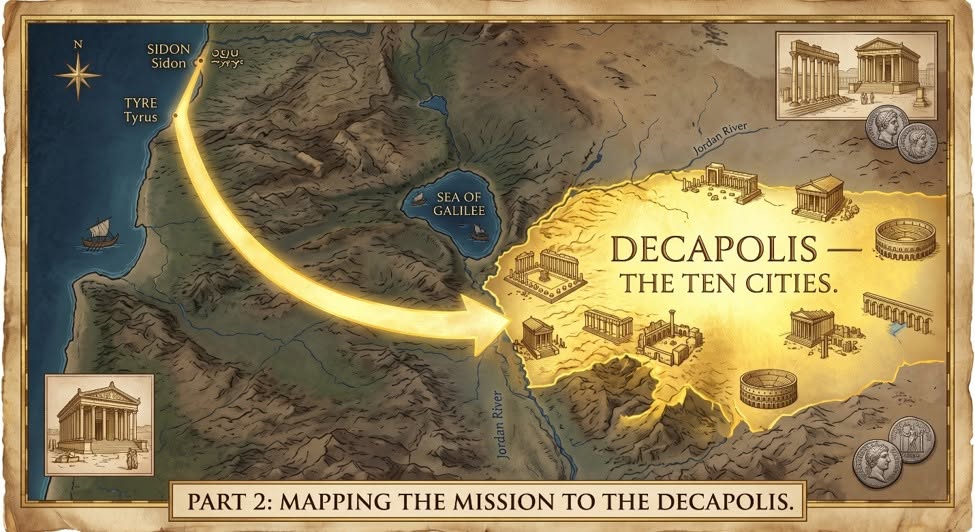
2. Mapping the Mission: What Was the Decapolis? (Mark 7:31)
After leaving Tyre and Sidon, look at the precise route Jesus took:"Again, departing from the region of Tyre and Sidon, He came through the midst of the region of Decapolis to the Sea of Galilee." (Mark 7:31)
Let's unpack what the Decapolis actually was:
The Name: Decapolis comes directly from two Greek words—Deka (Ten) and Polis (City). It literally means "The Ten Cities."
The Culture: Located primarily east of the Jordan River, this was a confederation of ten self-governing, highly Hellenized, pagan Greek cities established under Roman dominance.
The Religious Context: To an orthodox Pharisee, the Decapolis was the ultimate symbol of gentiles, pagan worship, and spiritual defilement. It was a region to be avoided.
Yeshua did not take a detour around it; He walked right through the center of it. He brought the Light of the Creator straight into a major Gentile stronghold.
3. Glorifying the God of Israel (Matthew 15:29–31)
When Yeshua arrived in the Decapolis, crowds gathered on a mountain bringing the lame, blind, mute, and maimed. Yeshua healed them all.
Notice the specific detail Matthew includes in verse 31:
"...and they glorified the God of Israel."
This is a massive textual clue. A Jewish crowd in Jerusalem or Galilee would simply say "they glorified God." But here in the pagan Decapolis, a non-Jewish, Gentile crowd was recognizing and glorifying the God of the Hebrews!
THE TAKEAWAY FOR TODAY
The Canaanite woman came asking for a single "crumb" from the table. But as we'll see in Part 3, when Yeshua meets people in the wilderness, He doesn't just pass out crumbs—He sets a full, overflowing feast.
Yeshua deliberately broke through cultural, geographic, and religious barriers to reach those who were considered far off. Are we limiting YHVH's work by staying inside human comfort zones, or are we willing to carry His truth into the strongholds that need it most?
Key Passages to Read Today: Matthew 15:21–31 | Mark 7:31
Stay tuned for Part 3: The Table in the Wilderness — Feeding the 4,000!