
A Rood Awakening!

Posted

05 May 17:11

🙌   Encouraging Word of the Week
69 %
📖   Bible Trivia Contest
38 %
❓   Bible Fact or Fiction
46 %
🧩   “Kids Corner” – Bible games & puzzles for kids
8 %
13 votes
4

Posted

05 May 07:34

Image from A Rood Awakening!'s post

Talitha Kumi

The record of the healing of the bleeding woman is one that I meditate on often. It reminds me of the intentionality of our God. It reminds me that He has laid out a perfect and miraculous plan of redemption for humanity – and of how He is able to use all things for good. It also reminds me of His sovereignty and how important it is to remain humble and yielded to Him. 

Because, you see... If it hadn’t been for the synagogue leader’s dying daughter, that unclean woman may have not crossed paths with the man of glory that day. 

I don’t think that YeHoVaH intentionally afflicted the twelve year old girl. But through her death, a woman who was well acquainted with suffering was healed. This is but an echo of the salvation and healing we have all received by the suffering of our King Yeshua. And yet, there is another shadow beautifully woven into this story. 

In Romans 11:11, Paul says, “…they did not stumble so as to fall, did they? May it never be! But by their transgression salvation has come to the Gentiles, to make them jealous.”

Jairus had faith that Yeshua could save his daughter from death itself, even after the flute-players had been called to begin grieving. But, he did not know that another woman would be saved on the way to his daughter’s resurrection. 

The Father knew. He knew that the little girl would be brought back to life, and that her temporary struggle would bring another grieving soul to salvation.

The woman who was unclean for twelve years had faith, too. She knew that if she could just grab hold of Yeshua’s tzitziot that she would be healed! 

I see such a clear parallel in this story. Twelve is always a reference to Israel. This almost-dead little girl, the daughter of the synagogue leader named Jairus, is like a temporarily-blinded Israel. 


“God gave them a spirit of stupor, eyes to see not and ears to hear not, down to this very day.” Romans 11:8

In YeHoVaH’s mercy and great grace, not only did His only Son offer himself up willingly on our behalf, but an entire nation – the Almighty’s beloved – was spiritually blinded so that the entire world would have the opportunity to grab hold of the tzitzit of King Yeshua. 

I also find it interesting that the unclean woman was in this condition for twelve years. She, too, is Israel as are all believers in Yeshua! 

This gives me such great hope! That means that YeHoVaH was aware of her affliction and suffering. From His position in the heavenlies, it would all be worthwhile because He had a plan not just to save her body, but to save her soul! 

How often do we grieve the way that Jairus and his family grieved over their dying daughter? It reminds me of the pain we feel for those who have not yet become believers in Yeshua. 

But what if their awakening is running on the Almighty’s timeclock? What if their blindness and suffering is intended to save another? 

One thing I know is that YeHoVaH is aware and desiring salvation and healing for them. Let’s be like Jairus and keep petitioning Yeshua on their behalf. 

And let’s remember to remain humble when we encounter those who do not believe, especially our brother Judah! We don’t know every detail of God’s sovereign and miraculous plan, but we do know that one day He will remove the scales from their eyes and say:

“Talitha Kumi!” 

Arise, little girl.

2

Posted

04 May 12:56

Image from A Rood Awakening!'s post

Verse of the Week: Zechariah 14:9

“And Yehovah shall be king over all the earth: in that day shall there be one Yehovah, and his name one.”

This verse gives the believer a clear horizon. History is not moving toward chaos forever. The nations are not ultimately ruled by kings, empires, ideologies, or antichrist powers. The final word belongs to Yehovah.

Zechariah points us to a real kingdom, a real King, and a real day when the God of Israel will be openly acknowledged over all the earth. This is not merely symbolic comfort. It is the prophetic hope of Scripture. Yeshua will reign. Jerusalem will matter. The nations will be brought under His righteous rule. Every false throne will fall.

For the follower of Yeshua, this should produce both sobriety and courage. Sobriety, because the days ahead will test the people of God. Scripture does not promise an easy road before the kingdom comes. It calls us to patient endurance, faithfulness, and witness. Courage, because the outcome is already declared. The Lamb wins. The King returns. The earth will be filled with the knowledge of the glory of Yehovah.

So this week, live with the end in view. Pray for Israel. Pray for the nations. Refuse despair. Do not measure reality by the headlines alone. Measure it by the promises of Yehovah.

Yeshua will be King over all the earth. Yeshua will reign from Jerusalem. That is where history is going.

2

Posted

04 May 09:38

Image from A Rood Awakening!'s post

Joseph Hewett answered 100% of our Passover Trivia questions correctly. He—and others who also achieved a perfect score—were entered into a drawing to win one of three limited-edition, hardcover first editions of The Chronological Gospels Bible, signed by Michael Rood.

Joseph recently received his prize and shared this photo, along with his response: “WOW, that’s awesome—thank you so much for the gift! I will thoroughly enjoy reading and studying. Thank you, thank you, thank you!”

1

Posted

02 May 09:00

Image from A Rood Awakening!'s post

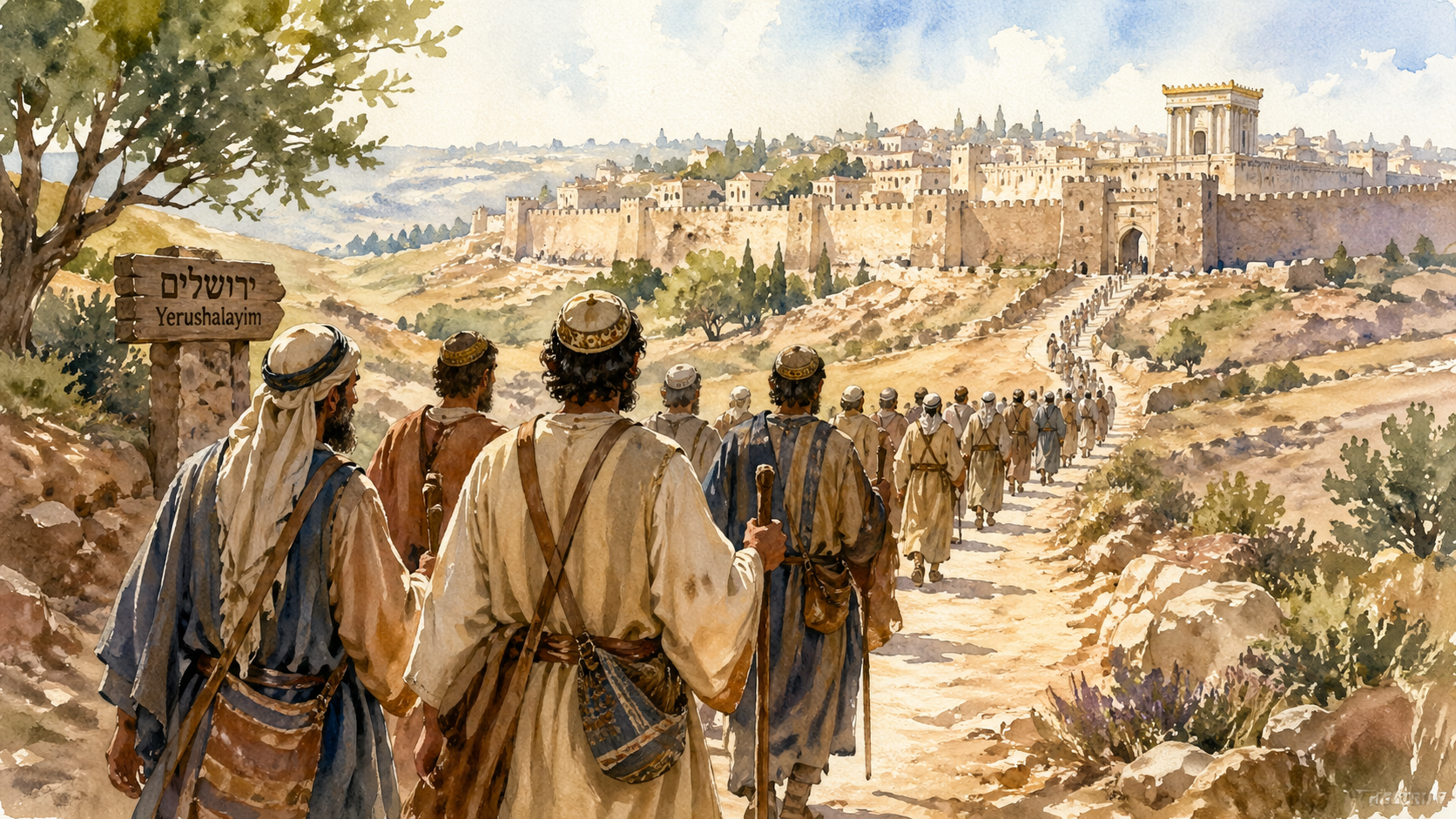
Chag (חַג) – The True Meaning of the Feasts of Yehovah

When we speak about the Feasts of the Creator or the Biblical Feasts, it is common to group all the mo’adim (appointed times) listed in Leviticus 23 into the same category. However, when we carefully observe the Hebrew text and set aside popular interpretations or later traditions, a striking insight emerges: not all mo’adim are chagim (feasts).

What Is a “Chag”?

The term חַג (Chag) refers, in its most specific sense, to a solemn celebration marked by pilgrimage, communal joy, offerings, and rejoicing before the Eternal. It comes from the Hebrew root חוּג (chug), which conveys the idea of “circling,” “going around,” or even “celebrating with circular dances.” This echoes deeply in the ancient practices of Israel, where dancing in circles during celebrations was a tangible expression of joy and unity. Thus, a chag is not merely a holy or set-apart time (mo’ed), but an event of active, collective participation—requiring ascent to Jerusalem and both physical and spiritual involvement from those who take part.
😀 Continue reading: https://aroodawakening.tv/chag-the-true-meaning-of-the-feasts-of-yehovah/

Posted

01 May 20:00

Image from A Rood Awakening!'s post

“My presence will go with you, and I will give you rest.” — Exodus 33:14

1

Posted

01 May 09:11

Image from A Rood Awakening!'s post

Living in the Light of Yehovah’s Appointments

Holiness shapes every area of life, expressed through obedience and honoring Yehovah’s appointed times.

Parashat Emor (Leviticus 21:1–24:23) unveils the blueprint for living in the presence of the Divine. It begins by defining the rigorous standards of holiness for the Kohanim (priests), reminding us that those who draw closest to Yehováh must reflect His sanctity in both their private lives and their public service.

The narrative then shifts from the sanctity of people to the sanctity of time, providing a definitive guide to the Moedim(appointed times). From the weekly rest of the Sabbath to the profound annual cycle of Passover, Shavuot, Rosh Hashanah, Yom Kippur, and Sukkot, these festivals act as eternal milestones of the covenant. The portion concludes with the perpetual light of the Menorah and a solemn reminder to guard the holiness of the Divine Name, ensuring that the heart of the community remains anchored in the reverence of Yehováh.

Go deeper at: https://aroodawakening.tv/community/parashah-leviticus/parasha-emor/

Posted

27 Apr 13:32

When I finally felt “found” by YHVH
54 %
When I recognized I was chosen
31 %
When I saw real fruit in my life
15 %
I’m still seeking that moment
0 %
13 votes
2

Posted

27 Apr 13:09

Image from A Rood Awakening!'s post

CLEANSE TO BE SET APART
Leviticus 16:1 - 20:27
Parashot Acharei Mot - Kedoshim

Precise instructions are established for sacred service after the death of Aaron’s sons, emphasizing that one cannot enter Yehovah’s presence just any way. The high priest had to follow a strict order on the Day of Atonement, including the use of two goats: one sacrificed and the other sent into the wilderness, symbolically carrying the people’s sin.

Then the focus shifts to daily life: pagan practices are forbidden, relationships are regulated, and justice, honesty, and love for one’s neighbor are required. Holiness is no longer just ritual—it becomes a way of life. The call is clear: the people must reflect the character of Yehovah in everything.

Explore the complete content here 👇

https://aroodawakening.tv/community/parashah-leviticus/parasah-acharei-mot-kedoshim/

Posted

27 Apr 13:03

Image from A Rood Awakening!'s post

EXALE INJUSTICE, INHALE FORGIVENESS

When Yehovah created us, we were endowed with a conscience. This serves as a judge, originally equipped to point us toward what is right or wrong according to the eternal Torah, which reflects the righteous character of the Creator and by which He governs all His Creation.

However, as we grow and begin to walk through this world, that conscience is influenced, educated, altered, and even contaminated. We can reach a point where we totally lose our sense of justice—as seen in many who do not hesitate to harm others to achieve their personal goals. It is then that we say of them: “They have no conscience!”

But when we have a real and transforming encounter with Yeshua, something supernatural happens: that conscience is restored and renewed to align once again with the Torah of Yehovah. A new beginning emerges, a new life, just as Shaúl (Paul) describes:

Therefore, if anyone is a new creation in the Messiah, the old things have passed away; behold, all things have become new.

2 Corinthians 5:17

At that moment, the potential to continue acting uprightly and justly is reactivated. Nevertheless, we often slip back into old ways, primarily due to the force of habit. We run the risk of returning to old paths, ignoring or disregarding our conscience, which is now alerted by the Spirit of Yehovahdwelling within us.

How to Face These Struggles?

In those moments, we must seize the resource provided by our Father to be restored in our walk: Confession.

I am not speaking of going before another man to give an account of what we have done. I am speaking of conversing with God, with Yehovah, to come into agreement with Him regarding what He defines as injustice. It is about accepting that He is right and acknowledging that what we have done is evil or incorrect. Then, by faith, we appropriate the forgiveness already granted to us through Yeshua the Messiah and move forward, perfecting our walk.

As the Psalmist wrote:

I acknowledged my sin to You, and my iniquity I did not hide; I said, ‘I will confess my transgressions to Yehovah,’ and You forgave the guilt of my sin.

Psalm 32:5

Reconciling with Others

You might ask: “What if I have acted unjustly toward someone else?” There will always be situations where we must go to the person we have wronged to acknowledge our error. This is also confession; in other words, it is coming into agreement with that person that I did them wrong. In this case, I must ask for forgiveness for such behavior. We should not demand it—saying “Forgive me for that…” as an order—but rather give them the option to make the decision to grant that forgiveness.

The Appointed Time of Restoration

Yehovah provides us with a special day during the Fall Feasts: Yom Kippurim, the Day of Atonement, or the day of release from the guilt we have carried throughout the year (or life). The tenth day of the seventh month of the Calendar of Yehovah is set apart for us to perform a self-audit. On this day, we are commanded to humble ourselves before Yehovah (which, in biblical language, signifies fasting). This day is considered a Shabbat in which no work is to be done; instead, we must withdraw into silence and stillness to settle our accounts with our Father.

To do this effectively, we need to prepare during the preceding days, engaging in introspection with our Father’s help to bring to mind those intentions, attitudes, and behaviors that need correction or repair. The first step to achieving this is Confession, as we have considered it.

A Daily Rhythm

In truth, we should not wait until the arrival of Yom Kippurimeach year to mend our relationships with our Father and others. This is something we need to do day by day, just as we do with our physical bodies through breathing: we exhale toxins and inhale fresh, pure air. In the same way, let us exhale our injustices through confession and inhale the forgiveness and righteousness that comes from Yehovah through Yeshua, our Lord and Messiah.

“If we confess (recognize) our sins, then, since He is trustworthy and righteous, He will forgive our sins and purify us from all unrighteousness.” — 1 Yochanan (John) 1:9